
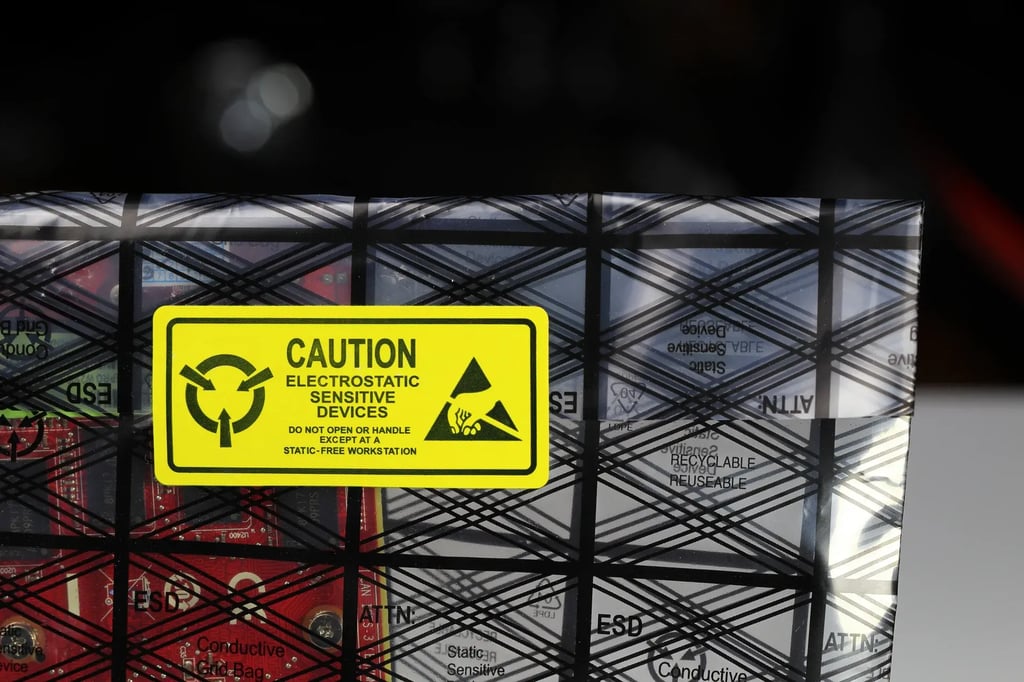
What “ESD-Safe” Should Mean in Packaging
Electrostatic discharge (ESD) can damage electronic components at levels too small to feel. Sometimes ESD causes immediate failure. Other times it creates latent damage that passes functional test but fails later in the field. That is why packaging is part of the ESD control conversation, not an afterthought.
A tray is ESD-safe when it helps control charge in a predictable way throughout your process. That includes how parts are loaded, how trays nest and stack, how they move on carts or conveyors, and how they are stored. If the tray’s material, design, or handling method allows uncontrolled discharge, the tray becomes a risk point.
The Three Material Buckets: Insulative, Anti-Static, and ESD-Control
Insulative trays
Standard plastics without ESD additives can act as insulators. Insulators can hold charge and allow that charge to remain on the surface until it finds a discharge path. For static-sensitive components, this is often the wrong starting point unless the tray is used inside a controlled shielding system that meets your internal requirements.
Anti-static trays
Anti-static materials are intended to reduce charge generation, often by changing how the surface interacts with friction and humidity. Anti-static does not automatically mean the tray will safely dissipate charge. For many electronics programs, anti-static alone is not a complete solution.
ESD-control trays (conductive or static dissipative)
ESD-control materials are formulated to provide defined electrical behavior. Two common targets are conductive and static dissipative. These are selected based on your program’s allowable resistivity ranges and the sensitivity of the parts being handled.
Resistivity Basics: Conductive vs Static Dissipative
Buyer conversations get cleaner when you talk in resistivity targets instead of generic labels. Surface resistivity is commonly expressed in ohms per square.
In many ESD programs, conductive materials fall at lower resistivity levels and allow charge to move quickly across the surface. Static dissipative materials sit higher and allow charge to bleed off in a more controlled way. The right target is driven by component sensitivity, grounding strategy, and your internal ESD control plan.
If your facility follows a documented program aligned to ANSI/ESD S20.20, your acceptable packaging ranges should be defined there or in supporting procedures.
What to Ask For: Documentation, Not Color

A common buying mistake is equating color with performance. Many conductive trays are black because carbon is a common conductive additive. That does not mean every black tray is conductive. It also does not mean a tray marketed as “anti-static” meets dissipative targets.
Ask for documentation that states the material classification, the resistivity range, and the test method used. If your quality system requires traceability, ask whether the supplier can link the tray lot to a material batch or formulation.
How Thermoformed ESD Trays Are Built
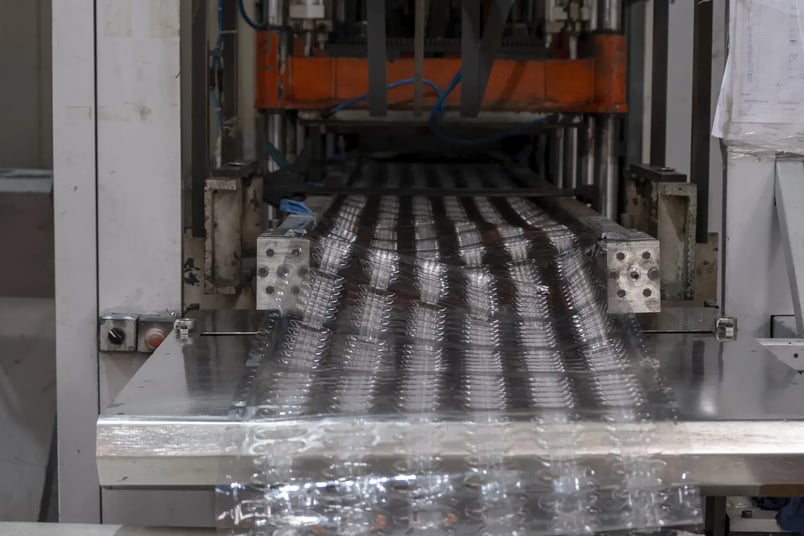
Most ESD safe packaging trays for electronics are thermoformed. Thermoforming starts with a plastic sheet, heats it to a controlled window, forms it over tooling, and trims it to finished size. For ESD applications, the sheet is compounded with conductive or dissipative additives so the electrical behavior is built into the material.
If you are comparing base resins and performance tradeoffs, start with Ready-Made’s plastic materials guide, then confirm which ESD formulations are appropriate for your requirements.
Formulation affects more than electrical behavior. It can change stiffness, impact resistance, surface finish, and how easily trays clean for returnable use. The correct choice depends on how many times the tray will cycle through your process and what mechanical abuse it will see.
Geometry Matters: Contact Points, Movement, and Stacking
Pocket contact strategy
Trays control where a part touches plastic. More contact can stabilize components, but it can also increase friction during loading and unloading. A good tray balances retention with minimal unnecessary contact on sensitive areas.
Nesting and stack behavior
ESD risk changes when trays stack. If trays nest tightly, surfaces can rub during transport vibration. If they stack loosely, parts can shift and create contact events. For many programs, stable stacking is as important as material choice.
Lids and cover options
If your process uses lids, confirm whether the lid material is also ESD-control and whether the closing method increases friction. A tray may be dissipative, but if the lid is insulating, you may create a mismatch in the system.
Shielding vs Surface Control
Some teams use the term “ESD-safe” to mean shielding. Shielding is different from surface resistivity control. A shielding package is designed to reduce the energy of an external discharge event reaching the device. A conductive or dissipative tray primarily manages charge on its own surface and helps equalize charge when used in a grounded environment.
In practice, you may need both layers. For example, a dissipative tray can control handling and stacking inside the facility, while a shielding bag or shielding tote can reduce risk during outbound shipment. The correct combination depends on your product’s sensitivity and the exposure risks in transit.
System Integration: A Tray Is Only One Layer
An ESD tray does not replace your ESD control program. It supports it. The tray should be selected based on how it will be used in a grounded environment: grounded benches, grounded carts, proper wrist strap use, and any ionization or humidity controls you rely on.
If a tray is conductive or dissipative but is used on an insulating surface, you can still end up with charge issues. Define the full handling path and verify that packaging assumptions match reality.
Incoming Inspection and Ongoing Verification
If ESD protection is a quality requirement, treat trays like any other controlled input. Define what documentation is required with each lot and what you will verify on receipt.
At a minimum, many teams verify that the received tray material matches the expected classification and that trays are not contaminated with insulating films, oils, or labels that change surface behavior in critical contact areas.
If you run a returnable program, consider periodic re-verification. Repeated cleaning, abrasion, and handling can change surface characteristics. A simple check schedule can prevent slow drift away from your target performance.
Practical Buying Criteria for ESD Safe Packaging Trays
Use criteria that procurement, engineering, and quality can agree on.
- Target material classification and acceptable resistivity range tied to your ESD program.
- Documented test method and evidence that performance is consistent lot to lot.
- Pocket design that protects sensitive surfaces and holds orientation without excessive contact.
- Stacking stability at your required stack height and under expected vibration.
- Compatibility with lids, racks, totes, and automation if applicable.
- Traceability expectations for regulated or customer-audited environments.
Stock vs Custom ESD Trays
If your parts fit a standard footprint and pocket arrangement, stock trays can be the fastest way to validate a concept. Stock also reduces the engineering and tooling steps required for a custom design.
To evaluate options quickly, you can Shop Stock Trays and request samples for fit checks.
For parts that need tight orientation control or special contact management, use the Custom Trays page to start a geometry and material review.
If you want to test handling and stacking early, request Free Samples when a comparable stock tray exists.
Common Pitfalls to Avoid
- Specifying “anti-static” when your program requires dissipative or conductive performance.
- Assuming black color equals conductivity.
- Buying trays without resistivity documentation and test-method clarity.
- Ignoring how trays rub during nesting, stacking, or transport vibration.
- Using an ESD tray in an otherwise uncontrolled handling environment.
Where Standards Fit: ANSI/ESD S20.20 and IEC 61340-5-1
Many organizations structure their ESD control programs around established standards. ANSI/ESD S20.20 is widely referenced for establishing an ESD control program. IEC 61340-5-1 is another commonly cited standard for protection of electronic devices from electrostatic phenomena.
Your packaging requirements should connect to your program requirements. If you do not have a documented packaging spec, a practical first step is to align packaging language to the same resistivity and handling controls used on the production floor.
Next Steps
If you are unsure whether you need anti-static, dissipative, or conductive trays, the quickest path is to review your component sensitivity and ESD program requirements against real tray geometry and handling steps.