
How to Choose ESD-Safe Packaging Trays for Electronic Parts
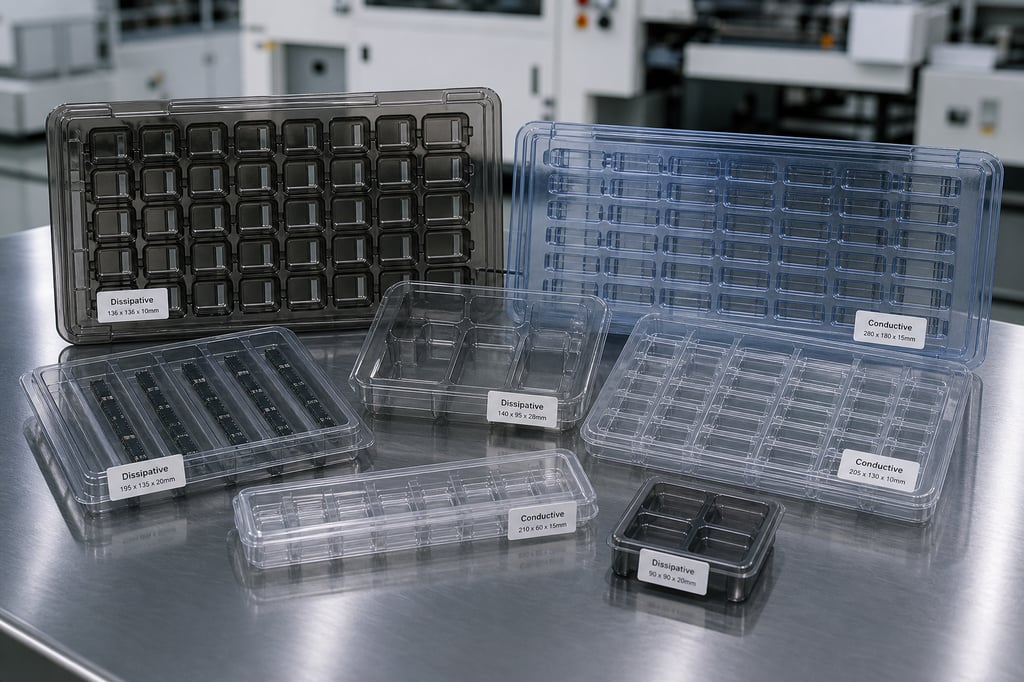
TL;DR
If you package electrostatic discharge sensitive parts, the right tray needs to do more than hold shape. It needs to support your ESD control plan, fit the part correctly, and make handling predictable from production through shipment.
- Choose tray material based on where the part will be handled, stored, and shipped.
- Use tray geometry to control movement, orientation, and contact points, not just footprint.
- Stock trays can work for some electronics parts, but custom ESD trays are often the better choice when fit, process flow, or protection requirements are tight
Why ESD Tray Choice Is a Packaging Decision, Not Just a Material Decision
Many buyers start with one question: do I need an anti-static tray? That is a fair starting point, but it is not enough to choose the right packaging. For electronic parts, tray selection should match the full job. That includes the part’s sensitivity, the handling environment, how operators load and unload the tray, whether trays stack, and whether parts ever move outside an ESD protected area (EPA).
That is why tray selection often becomes a custom packaging question instead of a simple material swap. Ready-Made offers custom trays in anti-static options, and its thermoformed plastic packaging materials page specifically calls out ESD prevention as a material-selection need.
What an ESD-Safe Tray Needs to Do
An ESD-safe tray should support protection in three practical ways.
- Control charge behavior through the right material choice for the application.
- Keep parts separated and stable so they do not rub, bounce, or shift during handling.
- Fit into the way your team actually loads, inspects, transports, and stores electronic components.
Industry standards matter here. ANSI/ESD S20.20 defines the framework for an ESD control program, and ANSI/ESD S541 covers packaging materials used to protect ESD susceptible items through production, transport, and storage. Those standards do not tell you to buy one tray shape or one resin. They tell you to match packaging properties to the risk and the environment.
How to Evaluate Material Type
The first decision is material behavior. In practice, teams usually sort ESD packaging materials into anti-static, dissipative, conductive, or shielding roles. The right choice depends on whether the tray will hold parts inside an EPA, move work in process between stations, or travel outside controlled conditions.
For many electronics applications, a thermoformed tray made from an ESD-capable material is used as the part-contacting package because it combines orientation control with static management. Ready-Made’s electronics packaging page highlights anti-static tray options for shipping and storing delicate components, and its materials page notes that custom material choices can be selected for ESD prevention, chemical resistance, and clean-room safety.
A few practical filters help narrow the material choice.
- If the tray stays inside a controlled production environment, the priority may be consistent handling and charge control at the point of contact.
- If the tray moves between facilities or outside an EPA, you may need a broader packaging system that layers tray protection with other ESD protective materials.
- If the part is highly sensitive, part-contact material and overall pack design usually need review together, not as separate decisions.
Why Tray Geometry Still Matters
An ESD-safe material will not fix a poor tray design. If the pocket is too loose, the part can rotate, climb, or contact adjacent parts. That creates handling errors and can increase abrasion or impact risk. For electronic components with leads, contact surfaces, or orientation requirements, geometry is often just as important as the resin.
That is where thermoformed trays have an advantage over generic bins or loose compartment packaging. A tray can be designed around pocket depth, wall angle, part spacing, finger access, and stack behavior. When that geometry is matched to the part, operators can load faster, pick more consistently, and reduce unnecessary touch points.
When Stock Trays Can Work
A stock tray may be enough when your part dimensions are stable, orientation is simple, and an existing pocket already gives you acceptable fit. That can be a useful starting point for prototypes, lower-volume packaging, or less complex electronic components.
Ready-Made keeps a broad catalog of stock tray options and offers free samples so teams can test fit before they commit. For electronics packaging, that sample step matters because it lets you check part seating, stack stability, and operator access before you decide whether stock is good enough.
When Custom ESD Trays Make More Sense
Custom trays become the better choice when the part is sensitive, the process is repetitive, or the fit needs to do real work. That includes cases where parts must stay oriented for assembly, where contact points must be controlled, or where the tray has to support stacking, inspection, or automated handling.
Ready-Made’s custom tray program is built for those situations. The company notes that custom trays are available in anti-static models and that pocket depth can go up to 2 inches, which gives engineers room to design for retention, clearance, and handling access. In other words, custom is not only about unusual shapes. It is often about making the tray perform correctly in the real workflow.
Questions to Ask Before You Order
Before you specify an ESD tray, make sure your team can answer a few basic questions. What is the part sensitivity? Where will trays be used? Does the tray remain in process, or does it ship? How much movement can the part tolerate inside the pocket? Does the tray need to stack, nest, or work with lids? If you cannot answer those questions clearly, you probably need a sample review or a custom design conversation before ordering volume.
That is also why it helps to involve packaging, manufacturing, and quality at the same time. ESD packaging is not only a materials issue. It affects throughput, part presentation, inspection, and damage risk across the line.
Next Step: Validate Fit Before You Scale
The safest path is usually simple. Start with the actual part, the actual handling flow, and the actual environment. Then test tray fit before you scale purchasing. For some programs, a stock tray sample will confirm that an existing option works. For others, the review will show that you need custom geometry and a more specific ESD material choice.
If you are packaging sensitive electronic parts and need better fit or better control, request a custom tray quote or contact Ready-Made to review your part dimensions, handling environment, and packaging goals
F.A.Q.
Are anti-static trays and ESD trays the same thing?
Not always. Anti-static describes one material behavior, while ESD-safe packaging decisions can also involve dissipative, conductive, or shielding functions depending on the application. The right choice depends on the part, the environment, and whether the package stays inside or moves outside an ESD controlled area.
When should I choose a custom ESD tray instead of a stock tray?
Choose custom when fit, orientation, part spacing, or handling access are critical. It is also the better route when you need tray performance to support inspection, repetitive loading, stacking, or a specific process flow.
Do ESD trays matter if my facility already follows an ESD control program?
Yes. ANSI/ESD S20.20 covers the overall control program, and packaging still needs to support that program. A poor tray fit or the wrong material can undermine otherwise good handling controls.
Should I request a sample before ordering volume?
Yes. Sampling helps you confirm part fit, stack behavior, and operator access before you place a larger order. It is one of the fastest ways to separate a workable stock option from a tray that only looks right on paper
Author's Bio
Ready-Made Plastic Trays Team. We design and manufacture stock and custom thermoformed trays in the USA for machining, contract manufacturing, and precision component industries. Our focus is reducing damage and improving handling consistency through engineered tray geometry.